Mentoring & Philosophy
All students have weekly meetings with Mat in the lab. We have weekly group meetings during semester. Everyone should play an active role in any online open meetings relevant to their projects. Your lab co-workers are all fantastic sources of inspiration and ideas. All of these help with reviewing your progress, thinking about your objectives and devising experiments.
It's also important to have periodic strategy meetings where we examine the last few months' work and set targets for the coming few months. The timings of these meetings are set, approximately, by UCL Research Log. For these meetings you should come prepared with a maximum of three Powerpoint slides covering:
- Key achievements in the review period
- Challenges/Roadblocks you've faced
- Aims for the next period (these can include big new things, not just the logical, incremental things).
We'll discuss these together and set aims you're happy with. We'll cover other things, such as:
- How to best structure your working day
- Reading wider than your project
- Writing up your data and thesis accurately
- Preparing now for your career aims
- How to make your project open source
- Any other help or inputs you need to make your project fun, fascinating and productive.
Everyone has different ways of working. There are few rules.
Some people like the early morning, some people are night owls. Some people enjoy long hours, some people don’t. I’ve seen people put in long hours and get little done, and I’ve seen people do short, regimented hours (for example because of caring responsibilities) and be extraordinarily focussed and productive. I will never check on your hours, but it's my job to check on what you’ve achieved and what you’ve thought about in a given timeframe. There are some general things that can be said about working hours:
- Lots of people have found that it can be productive to come in to lab and get an experiment going first thing, so that it can be doing its magic while you’re doing everything else you need to do, and so that the experiment can be monitored during the day and action taken (like a workup/column) the same day. If you find you're coming in to lab and immediately starting to think about lunch, you might want to change something.
- You should keep re-examining whether your working day is working for you. Are you in a good place with your schedule, or might you need to re-examine? It can be easy to get stuck in a rut if you’re not careful. Mix things up.
- You have access to a real-life science lab! Of the kind that maybe you dreamed about when you were little. It’s really amazing. You can do novel science any day of the week. You can run experiments of your own design. You, with your own hands, can make molecules that have never existed in the universe before. You can answer fundamental scientific questions all on your own. Don’t take this for granted. Before you know it, your project will be over and you may never again have such freedom. Use the time you have as fully as you can before it’s over.
- The lab is a communal place. It works best by people sharing expertise, papers and ideas. This happens best in person, not on WhatsApp. This means that it helps to be around lab when other people are around. If you notice that lots of people are in between 8 and 6, and you come in at 7pm, you might be missing out. If you don’t keep similar hours to others, it also makes lab maintenance harder, since it helps if you’re around to fix the piece of kit you’re responsible for when it’s broken, not hours after it’s broken. That said, the lab is available 24/7. With the right training, and if you’re following all the right safety protocols, you can work whenever you like. If you’re excited by your cool science, don’t fear that working weekends is weird. It’s really not. (Remember, Mat will never check to make sure you’re doing this).
- You live in a competitive world. If you want to get a job in science, or research, you need clear evidence of your awesome abilities, and that almost always means authorship on some good papers. You can increase your chances of getting those good papers by devising and carrying out lots of good, thoughtful experiments. Putting in lots of hours in lab does not guarantee success, but it helps to make it more likely. Often you will find that work goes in bursts - there can be periods of intense activity when you need to finish a set of key experiments and the momentum you generate in those times can be very satisfying. And then there are quieter periods where you can reflect, read, plan and write. You should mix the graft with the thought to make sure that your PhD is fun, fascinating and productive.
Writing Accurately vs Writing Well
When you join a lab, you will have been through a lot of education. You may feel that you can write. Most lab scientists are quickly disabused of this idea. Writing science is hard. You will find that your writing goes through a very large number of edits. Don't freak out. Don't lose confidence. We're always students of writing.
When you write something, the first thing to ensure is that it's error free. You can't be making little tiny errors that will distract your reader, like speling mistakes or annoying spaces where there shouldn't be any or repetition of words where words are not needed because words have appeared where edits should have been made. Generally speaking, don't submit anything for anyone to read (particularly Mat) if there are any simple errors in the document (i.e. things that Word can find and highlight). You may ask yourself "why do little tiny errors matter? Surely it's the substance of the writing, not the little things?" No. Errors are distracting and their presence suggests to the reader that the work has not been well thought through. It will appear cobbled together. The reader starts to doubt the quality of what they are reading.
The second thing to do when you're writing something is to make sure that the content is meaningful and correct. Sentences should appear in a logical order. Paragraphs should have a coherent theme, with new paragraphs being used for new thoughts. References should be used correctly (see elsewhere for more on this). Statements should be made that can be backed up with data. Words should be used precisely.
The third thing to do is to make sure it's interesting. There is no law that says that science should be dull to read. To convey the excitement of what you are doing you should make it interesting to read. To achieve this requires a lot of practice, training and editing. It is an aim for a PhD student to construct an interesting thesis.
Consider Your Audience
When you write, think about who is going to read it. How you write changes depending on your audience. For most student reports and theses your audience is someone of your level of education (e.g. another undergrad, or grad student) who is trained in your broad scientific discipline (chemistry) but who is totally unfamiliar with your project. We can call this a "same-level stranger."
Once you have a clear idea of your reader, you will be able to pitch the complexity and jargon suitably. There's no need to explain what a molecule is to a same-level stranger. But you might need to explain what a Minisci reaction is, or an alanine scan or a gametocyte.
Don't try to be too clever. Don't feel the need to include complicated terms in order to sound impressive. If your same-level stranger would not understand it, explain it. There is nothing more likely to switch your reader off than feeling confused by jargon.
There may be times you need to alter your writing because you're doing something for a different audience. When writing grant proposals, you can often assume a higher level of knowledge by your audience (at least for the technical bits). When writing for a general audience (e.g. a general science magazine) you may need to simplify things further.
Correctly Referencing the Literature
You reference (or "cite") a paper so that your reader can get more details about the statement you've just made. You don't cite a paper so that your reader is taken to the paper where you got that statement from.
So for example, let's say that at the beginning of your report or thesis, you want to say "Acetyl CoA is a molecule that plays an important role in many biological processes." A statement like this really needs a reference. There are three options for you. The first is to reference a review which is on the subject of acetyl CoA and its role in biological processes. The second is to reference some major research paper, or series of papers, which have demonstrated that acetyl CoA is involved in biological processes, and which have been cited by others many times. The third is to reference a research paper which has in it the sentence "Acetyl CoA is a molecule that plays an important role in many biological processes" because that covers your ass. What's the best thing to do? 1 is better than 2, and you should NEVER do 3. The purpose is to direct the reader to a bigger source of information. If you did 3, and just reference some other paper that says something similar to what you're saying, then the reader has not been directed to a more comprehensive source, and has to go one step back, and look at the references in the paper you've cited in order to find more information.
If this is surprising or confusing to you, go and read the first few paragraphs of any research paper. Look at the references that are included there. They will be richer, bigger sources of information. They will not be references to other small research papers that just say the same thing.
Writing Living Papers (As You Go Along)
This section is about a way of writing up your work as you go along, to improve your ability to plan your research and accelerate the submission of your papers. The upshot is: you need to be leading the writing of at least one so-called "living paper" at any one time.
During the course of a research project it can become easy to drown in experiments and data. You get caught up in finishing short-term goals and sometimes it's easy to neglect thinking about the big picture - the "Why am I doing this research?" or "What is my big aim?".
On the other hand, when you write up papers or write your thesis, the story of your project - why you did it and what's the impact - needs to be very clear. It's often the case that when you write up your work you realise that there are additional questions that need answering, or additional controls that were needed (which is why people writing up often need to come back into lab!).
So on the one hand you are busy in lab with the minutiae but on the other hand you need to keep clear in your mind the bigger picture. The need for these two ways of thinking is sometimes called "the rat's head and the ox's neck".
Now, we try to mitigate against this. You write interim reports. You present your work at group meetings, or at conferences. You chat about your work with others. All of these things help you to re-evaluate what you're doing and why, essentially checking that the whole project is going in the right direction, that you've not overlooked something obvious, that you're asking the most meaningful questions. There's no better way to learn than to teach.
But frequently it's the act of writing your research down that helps your brain engage with the project the best. When you write what you've done, you really need to present it in the very best light, in a way that is maximally robust and defensible. When you write an introduction, you're forced to ensure you're up to date with the literature. When you write the experimental, you're forced to ensure your data can support your conclusions. When you write the R&D, you have to engage with your research project's story, and to make sure the whole thing makes complete sense.
At the same time, to progress in your career, and to demonstrate your productivity and scientific abilities, you need to publish papers.
So to combine these things, you need to create a written description of your project's current status and have it on the boil at all times. In other words, you need to be writing "living papers" - a description of where you're up to in the form of a paper that is, when you've completed a piece of work, ready to submit to a journal. Rather than waiting for the end of a phase of experimental work before writing it up, you maintain a paper as you go along.
In the group's open projects, each Github repository has a place to do this - the "Story So Far" on the wiki. This is an excellent (low-tech) place to write up where the project is up to. It's the most valuable thing we write for project outsiders - people who want to know where we're up to. We're constantly being asked for this by potential contributors.
Alternatively, we can use Google Docs, which are perhaps better for defined pieces or work. Ultimately it doesn't matter which we use, since we can of course cross-reference them. But we want to minimise work, so we should pick one rather than the other.
A living paper contains the features of any paper:
- A working title.
- Your name and address, and the names of any other contributors to the research.
- An abstract (though this is often easier to write at the end)
- A couple of paragraphs of intro, setting the scene for the work and its justification, and ending with a clear research question
- R&D
- A conclusion
- References
- Experimental (this can be a separate document if it's v bulky)
Obviously the thing about living papers is that all the above changes over time. Data are added in, diagrams change, conclusions change. There are new subsections needed as a result of new data.
Each lab member needs something like this. You might find you need more than one - projects are often written up as multiple papers, each with a separate theme and research question.
For the early stages of paper writing, you could do a lot worse than consult George Whitesides' very nice discussion of what a paper is. You'll notice he says "A paper is not just an archival device for storing a completed research program; it is also a structure for planning your research in progress".
So, practical steps. Start a Google Doc or start contributing to a relevant Github wiki page. Share that with Mat so that you're on the same page. Start setting aside some time for writing regularly - if a week goes by and you've not looked at the paper, then you're neglecting it. Keep your diagrams/figures somewhere convenient with a sensible naming convention, so that you can easily update them as you need to. Importantly, you can link to pages in your ELN if you wish to, as a way to maintain a link between data you mention in the paper and where the data came from, or are kept. Make the Google Doc public ("anyone with the link can view") and put (between authors and abstract) this: "The licence for this living paper is CC-BY-4,0, meaning you can use anything contained in this paper for any purpose, provided you cite this paper".
Does this take time? Yes, particularly to do it well. Is it worth it? Yes. Not in the short term, but in the medium term (because it will help you plan) and the long term (because it will accelerate your being able to submit peer-reviewed publications).
Checklist of Common Little Errors
Sometimes there is formatting in Word that you can't see. You can reveal formatting if you click the little backwards "P" that looks like this in Word Home Bar:

This can show that you've double spaces and other things. In particular it can reveal a spacing SNAFU that arises often when you copy from a non-Word source into Word, where the spaces appear as little blue circles, like this:
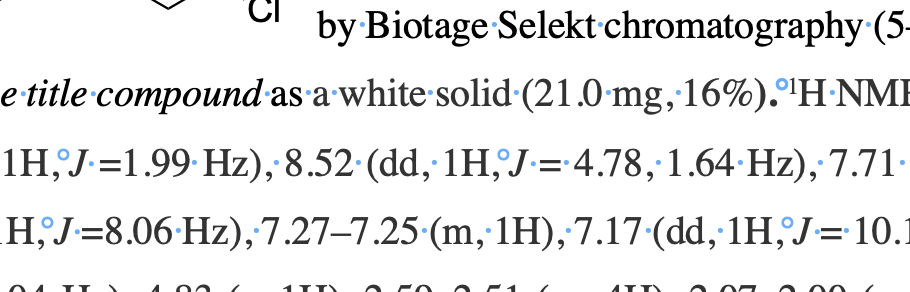
These can mess up spacing of your text and you should replace them with regular spaces. Usually if you paste into a simple text editor and then copy from that to Word, these odd spaces aren't carried over.